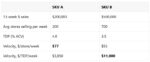

We’ve written before about why Sales per Store per Week ($PSPW or UPSPW) can be a flawed velocity measure. Our primer on this topic explains the problem. For example, a Walmart store and a 7-Eleven store each count as one store, so per-store velocity is biased toward items sitting in big box retail, since larger-format […]

Glossary
Crowdsourcing Common CPG Calculations and Formulas
A reader recently asked if we could recommend a reference document resource that contains a comprehensive list of calculations or formulas used in CPG. While our Glossary currently contains over 75 terms and abbreviations (many with calculations), we are considering expanding our glossary scope beyond syndicated data to cover other types of CPG metrics. We […]
% ACV Distribution
Measures the breadth of distribution of a product. Kind of like % of stores selling, but bigger stores get heavier weight. A point of distribution in the Total US is worth more than a point of distribution in Chicago, which is worth more than a point of distribution in Des Moines. Keep in mind that […]
% ACV with Merchandising
Measures the breadth of merchandising support. Can be used with any of the Merchandising Conditions (Price Reduction Only, Feature Only, Display Only, or Feature & Display). Same measure as % ACV Promo. Reference articles: The Beginner’s Guide to Trade Merchandising Measurement, All About ACV
% Discount
Amount that the promoted price drops below the regular price, expressed as a percentage. Calculated as (Base Price – Promoted Price)/Base Price. A higher number means a deeper discount. A deeper discount for the same tactic almost always results in a higher lift. % Discount is available by merchandising tactic on custom databases. Reference article: […]
% Stores Selling (PSS)
Percent of Stores Selling is also called Numeric Distribution (especially outside of North America). Within a given geography the % of stores where a product has scanned. For example, if Retailer X has 90 stores and Brand A sold in 72 of those stores then % Stores Selling = 72/90 = 80%. While this is […]
