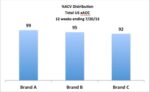
As mentioned in a previous post, shoppers cannot buy something if it’s not in the store! That’s why having good distribution is so important to your business. What can you do to increase distribution when your brand is already in at least 90% ACV distribution? Let’s look at an example. Say there are 3 brands […]
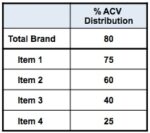
How to Calculate Average Items Carried
If Average Items Carried (or Average Items Selling) is not available on your database, it is easy to calculate in Excel. It is just the sum of % ACV Distribution of all the items divided by the % ACV Distribution of the brand. Here is an example: Say a brand is made up of 4 […]
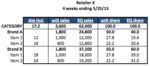
How Do I Calculate Equivalized (EQ) Sales?
One of our readers in the UK asked the following question after my recent posting on the different sales measures: “How can I calculate equivalized sales? If there is a formula for that, can you please send it to me?” If you have a custom database, then you probably already have EQ sales as a measure, so you don’t […]
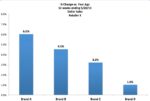
Business is Good! (Or Is It?): Ways to Measure Sales
Assume there are 4 brands in your category at Retailer X, with dollar sales growth as shown in the graph below. Which brand would you say is performing the best? How about the worst? Since this is not a trick question, Brand A is performing best with dollar sales growing the fastest, at +6% vs. […]

xAOC and MULO: Multi-Channel Markets in Nielsen & IRI
Are you confused by the terms “xAOC” or “MULO?” Do you wonder what happened to FDMx? (Do you even know what FDMx is?) This post will clear things up for you! These are the terms that IRI and Nielsen use for their multi-channel markets. These markets are designed to provide an estimate of sales across […]
Timing is Everything, Part II: Which Time Period(s) Should I Look At?
For a quick refresher on which time periods you can get on your database, see this previous post: Timing is Everything, Part I. Given all the possible time periods that you may have access to, it is important to first determine what business question you are trying to answer. There are 2 ways to think […]